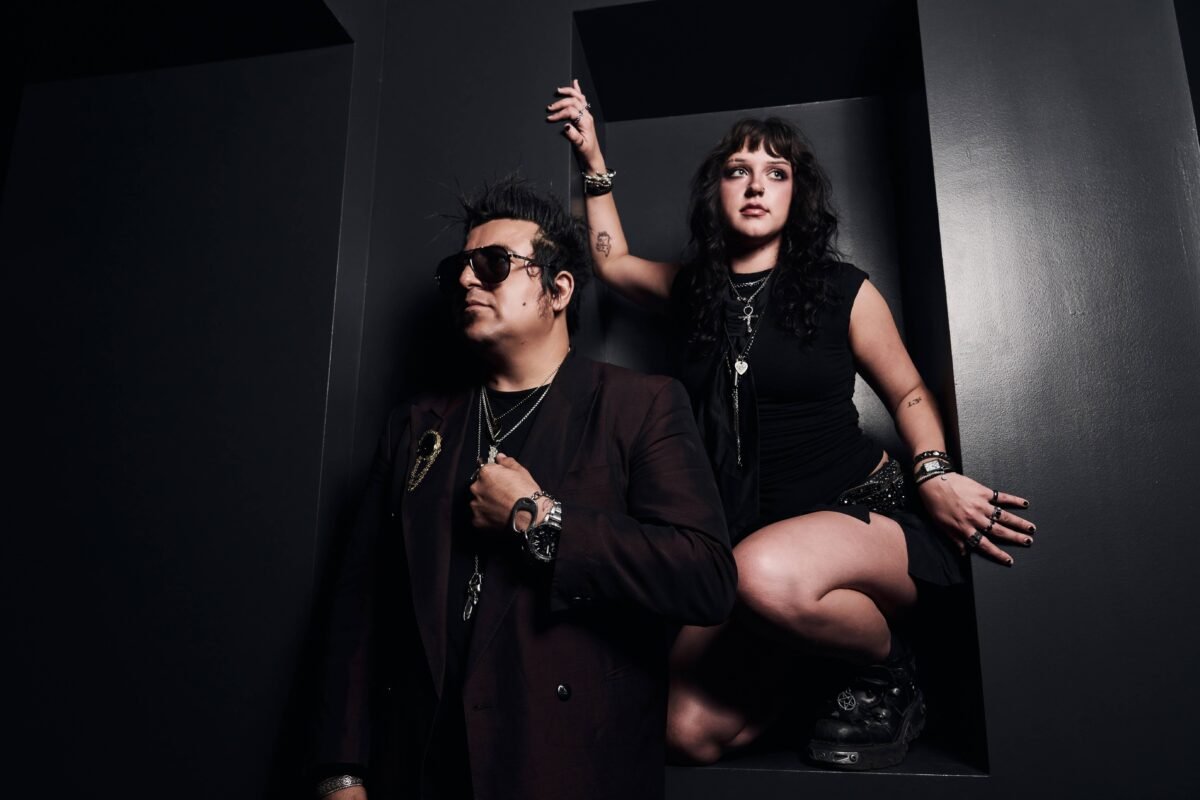

In this exclusive Q&A interview, Christopher Leyva of The Falling Doves answers questions from Music Beats Daily.
For more than 13 years, The Falling Doves have been carving out their own corner of rock music, mixing British guitar rock, post-punk and new wave with a dose of old-school Sunset Strip glamour. Led by Christopher Leyva alongside bassist and vocalist Katie Harold, the band has just released two albums and is currently out on a UK tour with a purpose that goes well beyond the setlist.
When the tour came close to falling apart, the band chose to turn a difficult moment into something meaningful, partnering with Music Support to raise awareness and funds for musicians and crew facing mental health struggles, addiction and burnout. Along the way, they have been sharing stages with local artists in every city and putting community at the centre of each night. That support for emerging talent is a theme across many of the artist interviews we have featured this year.
In this interview with Music Beats Daily, Christopher opens up about the band’s sound, the pressures of life on the road, what the music industry still gets wrong about artist wellbeing, and why no show should ever be treated like a rehearsal.
For readers who are just discovering The Falling Doves, how would you describe the band and the sound you and Katie have built together?
The Falling Doves are an eclectic collision of British guitar rock, post-punk, new wave, and a little of that old Sunset Strip glamour. There’s a strong emphasis on confessional songwriting, melodies, and the kind of raw energy that sometimes gets lost in modern rock music.
Katie has brought an entirely new dimension to the band. She’s not simply another musician onstage; she brings her own musical identity, perspective, and emotional depth to what we do.
Having two distinct voices allows us to explore different sides of the same story. It gives listeners two personalities to connect with, and I think that makes the music much more interesting.
We’re not particularly interested in fitting neatly into one genre. We take everything we’ve absorbed over the years and turn it into something that feels like us.
Your music blends British guitar rock with Los Angeles glam. Where did that combination come from, and which artists shaped you most?
We’ve spent years fighting for our place in the musical food chain, and I think our sound is a reflection of that journey.
The combination of British guitar rock and Los Angeles glam came naturally. There’s something about the songwriting tradition of British rock that I’ve always connected with, but there’s also an undeniable theatricality and danger to the music that came out of Los Angeles.
More importantly, our sound has been shaped by the extraordinary number of artists we’ve shared stages with over the years.
Some are legendary musicians, others are completely unknown outside their local scenes. Both have influenced us equally.
We’re grateful to the hundreds of artists we’ve encountered who have challenged us, inspired us, and sometimes forced us to rethink everything we thought we knew about our own music.
I think that’s how you grow as an artist. You stop worrying about where you belong in the food chain and start paying attention to what you can learn from the people around you.
What are you working on musically right now? Is there a new release or project you’re especially excited for people to hear?
We’ve been working on several collaborations and have another album that we’re gradually introducing to the world.
But we’re in absolutely no hurry.
We’ve just released two albums, and I think there’s something to be said for allowing music to breathe rather than constantly feeding the machinery of the industry.
There’s this ridiculous expectation that artists need to keep producing content just to remain relevant. Sometimes you need to give the music, and the audience, a little space.
Right now, people can check out “Blinded by Your Love” on all streaming platforms.
We’re enjoying the process of creating without putting unnecessary deadlines on ourselves.
What made you decide to tie this UK tour to mental health and Music Support? Was there a personal moment or experience behind it?
Sometimes, when everything starts falling apart, you discover an opportunity to do something much bigger than yourself.
This tour came dangerously close to falling apart, and suddenly we found ourselves having to rethink everything.
What started as an incredibly difficult situation became an opportunity to focus on something far more meaningful than simply getting onstage and looking cool.
It made us confront something that I don’t think the music industry talks about nearly enough: the human cost of what we do.
Exhaustion, pressure, constant travel, financial expectations, and the relentless demands placed on artists can take an enormous toll.
And sometimes the industry forgets that the people standing onstage are actually human beings.
There’s a disturbing tendency to turn artists into products, or worse, cash cows, without considering what happens when the person behind the music reaches their breaking point.
Working alongside Music Support gave us an opportunity to turn a difficult experience into something constructive.
If we can use our platform to encourage even one musician or crew member to ask for help, then we’ve accomplished something far more important than selling another ticket.
Life on the road can be tough. What have you learned about looking after yourself and each other while touring?
I’ve learned that you have to make time to actually live.
It’s easy to get so caught up in the schedule that you forget where you are, what you’re doing, and why you started playing music in the first place.
We try to make time to enjoy ourselves, explore the places we’re visiting, and simply be present.
But perhaps the most important thing is checking in on one another.
Touring can be particularly difficult for people who have families and responsibilities waiting for them back home.
Everyone carries something with them that you might not see.
You never really know what battles someone else is fighting, and sometimes a simple conversation can make an enormous difference.
We’re a band, but we’re also a little traveling family. You have to look after your people.
What do you think the music industry still gets wrong about the well-being of artists and crew, and what would you like to see change?
I think the industry often plans tours around geography, finances, and availability without giving nearly enough consideration to the physical and psychological consequences.
People underestimate the wear and tear of constant travel, changing time zones, lack of sleep, and the pressure to perform at your absolute best every single night.
It genuinely breaks you down.
And eventually, it affects the performance, your relationships, and your overall well-being.
There’s a tremendous difference between being passionate about your work and being pushed beyond your limits.
I would love to see more realistic touring schedules, better communication, and a genuine commitment to the welfare of everyone involved, from the artist to the person loading equipment into the venue.
The industry needs to remember that musicians aren’t machines.
You can’t simply keep pushing people until something breaks and then act surprised when it happens.
You’ve shared stages with local artists like Joe Leath and Phil “Volcano” Quinn on this tour. Why is it important to you to bring the local music community into your shows?
Because rock ‘n’ roll has always been about community.
We have a responsibility to support the next generation of musicians, but I don’t see it as an obligation. I see it as one of the greatest privileges of what we do.
We’ve spent years sharing stages with artists from all walks of life, and some of the most inspiring musicians we’ve encountered aren’t necessarily the ones with record deals or millions of followers.
They’re the ones playing their hearts out in small clubs because they genuinely love music.
Bringing local artists into our shows creates something special. It gives audiences a chance to discover new music, helps build relationships between musicians, and reminds everyone that we’re part of something much bigger than our individual bands.
And honestly, you make some incredible friends along the way.
That’s something no amount of industry success can replace.
Of all the venues on this run, is there a night or a city that has stayed with you so far?
There are little moments in every city that stay with you.
One of my favorite experiences was sharing the stage with London’s X-Ray Love, who have this fantastic sound that’s somewhere between Siouxsie and the Banshees and Blondie.
Their energy was infectious. It actually made us want to raise our own game and complement the evening with that same intensity.
But here’s something I feel very strongly about.
Not every room is going to be packed.
Sometimes you walk into a venue and there are fewer people than you expected. That’s just the reality of touring.
What drives me absolutely crazy is when musicians dismiss those nights by saying, “Oh, it’s just another rehearsal.”
I think that’s bullshit.
Not for us.
We travel way too fucking far to treat any performance like a rehearsal.
Whether there are 20 people or 2,000, those people made the effort to come and see you.
They deserve everything you’ve got.
Some of the most extraordinary moments in live music happen in the smallest rooms, and I’d hate to think we ever missed one because we were too busy counting heads.
What would you most like fans to take away from a Falling Doves show, beyond the music itself?
I can promise you one thing: it will never be monotonous, and you’ll never see the same show twice.
That’s a guarantee.
I don’t believe in simply going through the motions, playing the songs, and collecting a paycheck.
I want people to feel like they’ve been part of something.
There’s an exchange of energy between a band and an audience that you simply cannot manufacture.
Whatever you give me, I’ll give it back twice as hard.
That’s how I’ve always approached performing, and I don’t intend to change.
What’s next for The Falling Doves after this tour, and where can people follow your journey?
Honestly, the fact that we don’t know exactly what’s next is part of the gift.
It’s a little frightening, but it’s also incredibly exciting.
After more than 13 years of making music, we’re still evolving, still experimenting, and still finding new ways to challenge ourselves.
One thing I’m particularly interested in is taking our live production to another level.
I want to make the shows more visually stunning, with more ambitious lighting, atmospheric effects, and a stronger theatrical element.
I’ve always believed that a great rock concert should be more than a collection of songs. It should be an experience.
Something that stays with you long after you’ve left the venue.
We’ve never been particularly good at standing still, and I don’t think we’re about to start now.
People can follow our journey through our official website, thefallingdoves.com, and our social media channels.
The next chapter hasn’t been written yet.
And I think that’s the most exciting part.
ooking for more conversations with working artists? Read our interviews with hip-hop up-and-comer LA Reezy and Jessie Ware on Superbloom.
Follow on Instagram: @fallingdovesmusic